
From Fragmented Effort to Coordinated Action – Frame The Future
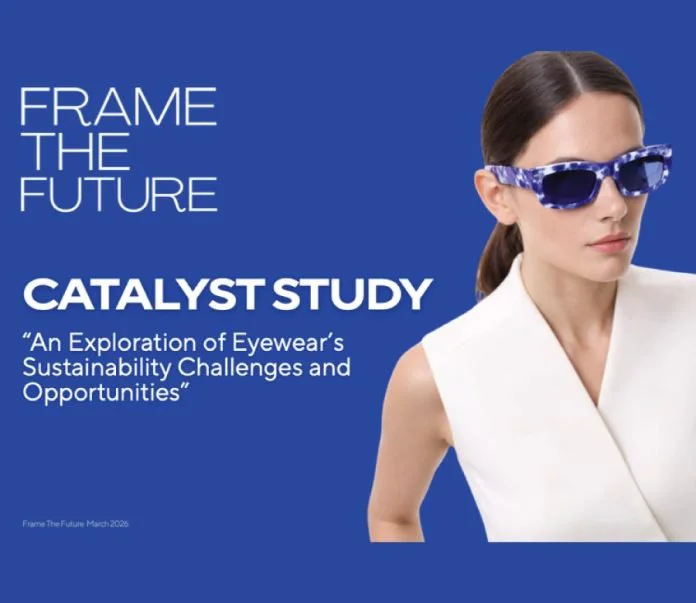
A new industry whitepaper published by Frame the Future (FTF) argues that eyewear’s sustainability challenge is no longer primarily technical; it is structural. The FTF Catalyst Study maps the barriers preventing progress from scaling across the industry, from materials and manufacturing to retail, communication, and end-of-life.
Based on 19 in-depth interviews across the value chain, supported by expert input, desk research, and cross-sector benchmarking, the study finds that the eyewear sector does not lack innovation or intent. What it lacks is coordination. Fragmented standards, inconsistent terminology, limited recycling infrastructure, weak data comparability, and growing regulatory pressure are making it harder for companies to act effectively alone.
The report identifies six structural barriers slowing progress: the data wall, the trust gap, the price trap, the waste engine, the retail filter, and the hidden footprint. Among the issues highlighted are high material losses in acetate production, limited traceability, persistent waste from demo lenses and mixed-material products, and a lack of shared systems that would allow circular solutions to move beyond isolated pilots. The study makes a clear point: these challenges do not stop at the factory gate. Retailers and opticians sit at a critical interface between industry efforts and consumer understanding. Without shared language, practical tools, and credible claims, sustainability often breaks down on the shop floor — affecting trust, staff confidence, and the ability to turn progress into customer relevance.
At the same time, the regulatory backdrop is changing fast, with increasing relevance of frameworks such as CSRD, EPR, Digital Product Passport requirements, and Green Claims enforcement. The study’s core message is that many of these pressures are systemic, and that responding to them company by company will be slower, costlier, and less credible than building shared foundations together.
Participating companies named in the study are: Ace & Tate, Bird Eyewear, ic! berlin, DSW Optical, Friendly Frenchy, Hoya, Safilo, Sea2See, Skans, Specsavers, Killine, Marchon, Marcolin, Mazzucchelli, Mod Style Eyewear, MYKITA, Pricon, Regenesis Materials, and Vanni.
Frame the Future is the newly founded non-profit and pre-competitive alliance behind the study. It brings together stakeholders across the eyewear ecosystem to help build the common conditions the sector cannot create alone: shared standards, aligned measurement, circular pilot infrastructure, and trusted cross-value-chain collaboration. Companies join FTF not only through membership, but by endorsing the Frame the Future Charter, a shared commitment to move sustainability in eyewear from fragmented effort to coordinated execution.
FTF is open to companies across the industry, including brands, manufacturers, suppliers, laboratories, retailers, recyclers, and solution providers that want to help shape the future operating conditions of responsible eyewear. The study can be downloaded free of charge from framethefuture.org, where membership information and Charter sign-up details are also available.
About Frame The Future
Frame The Future (FTF) is a global non-profit alliance and action platform dedicated to accelerating sustainability in the eyewear industry. Frame The Future brings together brands, retailers, suppliers, innovators, and experts to turn shared ambition into real-world action through collaboration, standards, and practical solutions. The eyewear industry faces both growing pressure and significant opportunity. Progress is currently constrained by a continued dependence on fossil-based materials, increasing material waste, a lack of effective recycling solutions, and limited transparency across value chains. These challenges are further compounded by fragmented efforts, weak collaboration, and rising compliance demands driven by evolving regulations. While many companies are motivated to improve, the industry lacks a unified framework to advance collectively. Frame The Future was created to bridge this gap.
Original link: https://www.opticaljournal.com/from-fragmented-effort-to-coordinated-action-frame-the-future/